
The «land of eagles» and cultural raki is opening up to tourism but doesn't want to forget its identity. Tour operator TUI has already knocked on the door and is juggling rapid development with preservation. Field visit.
By Béatrice Demol

A country under construction, welcoming without selling itself out, Albania must be wary of those who want to buy its identity for a few million tourists. While the Riviera is under pressure, the rest of the country remains entirely preserved.

Facing explosive growth in tourism, much like Turkey and Croatia did twenty and thirty years ago, the country must, above all, successfully navigate the transition from mass tourism to quality travel, and from large-scale state-led projects to small local operations—often funded by the diaspora, which accounts for nearly 50% of Albanian citizens. The stakes are immense. On our first visit, we experienced the pleasant sensation of having traveled back in time, to an era when discovering a place still meant something. Let’s hope it lasts.
The words for smile in Albanian
A few words scribbled in my notebook: Thank you, Goodbye. Hello, Thank you, Goodbye. Easy. Albanian is the only language that is spoken as it is written. 36 letters on the Latin alphabet and, depending on the region and the mood of the day, a stress accent that shifts to give an almost singing intonation, but always very energetic. These three words are enough to bring a smile to the closed faces of those who welcome us, even if we don't understand anything they say in response.

We are in the heart of the Balkans. Albania bears the weight of regional instability and complete isolation for over half a century. Life remains harsh, like the mountains. And Albanians appear proud and determined, forged by a culture of survival and community solidarity in the face of a dictatorship that the world has little documented. The discovery is all the more authentic for it.


Besides, our guide doesn't intend to drop us off at the beach – except for accommodation, as we're still standing with our feet in the water, and the most beautiful seaside resorts are in the south, beyond Vlorë, the gateway to the famous Riviera. We won't go any further, and that's enough to grasp the sincerity of the landscapes and the people who traverse this unknown land. Enough to make us want to follow the Ionian Sea all the way next time.
Durrës: History and beach beneath the concrete
You have to earn the port city of Durrës, facing the Adriatic Sea. From Tirana airport, quickly cross the featureless expanses, cement plants, unfinished buildings, and car rental agencies – the most common profession after car washers. Then, let yourself be drawn into the large expanse of greenery, pine forests that alternate with a chaotic line of hotels under construction, typical of southern European coasts in the seventies. This is called unplanned tourist development. Quickly, the air and light assert themselves, a smell of burnt pine and salt, terraces appear, then the sea and the Albanian coast.

Coastal Giants: Volume Hospitality
On the palm-lined Taulantia promenade, a few tourists mingle with locals around a seafood platter. An ageless little lady selling trinkets is gently reprimanded by two police officers who greet her neighbor, who must have the right connections. Two teenagers walk up the beach with their surfboards. Umbrellas are being put away and cocktails are being served. Two new hotels are housing our return from excursions. The first is a large, chic, and kitschy family-friendly all-inclusive located in Golem, the resort's largest beach: the Grand Blue Fafa Resort. The second, the Melia Durrës, on San Pietro beach, is another coastal giant but designed in such a way that it doesn't feel like it. Clean lines and elegant design succeed in the impossible feat of making you forget there are ten restaurants and bars, a casino, and eight pools, including two on the roof. Trees, dunes, and gardens hide the property's view from the private beach, while conversely, most rooms offer a view of the Adriatic.

Resilience through Laughter and Ridicule
Above the beaches of Durrës, which only come alive in season, on the heights, you can visit the Roman elliptical amphitheater from the 2nd century.ème century, the largest in the Balkans, completely out of place amidst residential buildings. You can enjoy the panorama from the terrace and bar overlooking the castle tower, of which only a few ruined ramparts remain. And, in the historic center, which is lively year-round, you can admire the renovated Venetian-style floors of the almost ‘luxury’ boutiques on the avenues. Finally, the private Peeping Tourists museum (www.peepingtourists.com) – a tragicomic immersion into Albanian tourism under the communist regime – is preferred over the classic Martyrs Museum. It notably reveals how dark humor contributed to the survival of the population, who lived under a cruel and paranoid regime for over forty years.
Tirana: Chaos, Colors, and Living Memory
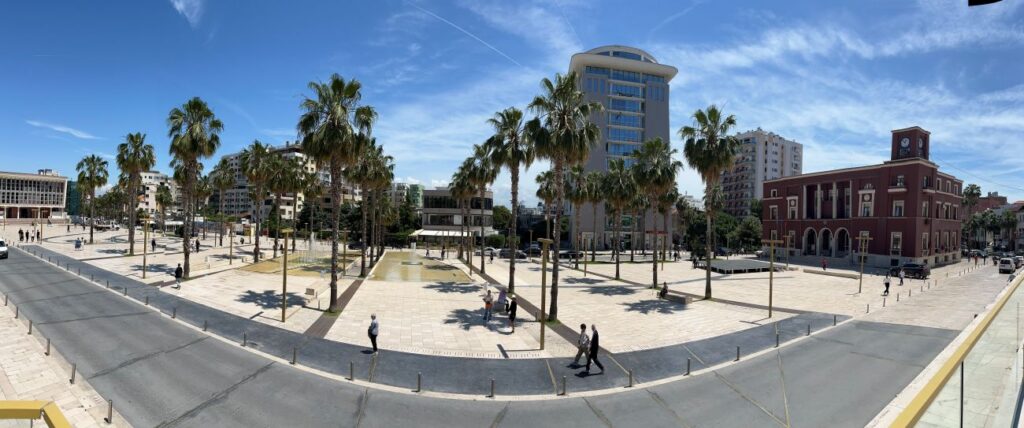
Many find the capital chaotic. I find it vibrant. Tirana doesn't try to please and hides nothing. Skanderbeg Square, domed in its center to offer a 360° view, is a political theater. The opera, whose first stone was laid by Khrushchev, the Et'hem Bey Mosque erected by the Ottomans, the ministries with fascist facades from the Italian occupation, the pyramid converted into a cultural center – each building tells a different era.

Along the streets, the same historical chapters: colorful blocks, St. Paul's Cathedral, the new Namazgah Mosque funded by the Turks, the dictator's Villa 31 transformed into an artists' residence, the Adrion bookstore where one can browse books on large sofas before buying a copy of the Kanun – the collection of traditions. Bunk'Art 2, the famous nuclear bunker reserved for dictator Enver Hoxha and his elite, in addition to housing bloody interrogation cells, has become the Museum of Memory. 170,000 bunkers were built across the country, most are abandoned, some have been transformed into museums, cafes, exhibition halls, residences, or hotels.

Street Art and Communism, the Trendy Heart of Tirana
The Blloku district, once reserved for the party and the secret police, has become the trendiest spot where, during the day, tourists admire street art and chic boutiques. In the evening, Tirana forgets its painful past in trendy cafes. At Komiteti Bar, the decor offers an intense dive into the communist years and its menu features the largest collection of rakis in the country, some thirty varieties (vanilla, cinnamon, honey, chili...). This local brandy is so strong that often, one is unable to appreciate its aromas.

Raki and Kanun, two pillars of Albanian identity
Raki burns the throat and opens doors. A direct legacy of the Kanun, the book of Albanian laws, it embodies pride, hospitality, and the given word. Each family distills its own liquor in the backyard or courtyard, and the drink accompanies all daily rituals—meals, ceremonies, disputes, reconciliations. If you are served one glass, it is to welcome you. Two, to show you they trust you—after all, three generations were confined in fear and rejection of the other. Three, to express friendship. At least for one night…


Big, somewhat gruff males
The Kanun mentions raki as an integral part of customary hospitality. This work is the bible of the Albanian people and can be bought everywhere. First transmitted orally from pre-Ottoman invasion tribal societies until the early 20th centuryème century, this code of legal and moral life has long been law in regions where the state could not control daily life. If blood crimes are not counted more than by the tens each year, certain societal rules dictated by this collection of customary law remain in effect throughout the country: hospitality, respect for family and elders, clan organization, local mediation. On the other hand, while Albania has aligned itself with European laws regarding women's rights, the Kanun itself is an absolute model of patriarchy. Far from the cities, debate does not always have a place. And it is through humor and diplomacy that the visitor can challenge these rather rough, macho men – and feel they are supporting women's rights in their own way.


Lac Bovilla, the jeep adventure in the mountains
Albania is a great playground for nature, mountain, and lake lovers. Wild camping has retained its noble status, and families are having a blast amidst the goats. Backpacks are not just for show. Nature is rugged but welcoming. A stop on the terrace of a farm-winery, with rough wines and rakis, a few words to the waiter, and you know you're still in a tourist no man's land. Destination: the ascent to Lake Bovilla, the turquoise mirror nestled in the limestone mountains of Daiti National Park. In the back of a jeep, hair in the wind, a feeling of freedom that makes the driver smile. He turns up the volume: Maître Gims' music drowns out the screeching tires, and the seats confirm they've been through a revolution.

Along the roads, the life of a country that hardly anyone knows, since access for travelers is mainly by the beaches. But Albania is worth more than its already known slogan. The sun, the sea, and sweet prices. There is also: The country where fields are still cut by hand or else Choosing the lakes. Because that's what parades before our eyes. A succession of scenes from another era, along the only main road that crosses the country from north to south – to stray from it, choose a good guide. Mountains encircle villages where, first you take shelter, then you welcome.

Krujë: The Citadel That Tells Albanian History
A winding road leads to Krujë, the paved cradle of Albanian identity. It was here that the hero Skanderbeg held out against the Ottoman Empire for 25 years in the 15th century. From the fortress ramparts, the view encompasses the plain all the way to the Adriatic. On a clear day, so they say, you can see Italy. In the restaurants, pasta and pizza compete with Byrek and Qofte. In the national museum, the demigod still wears his helmet topped with a goat's head.

Krujë Bazaar: Local Raki, Turkish Coffee, and Authentic Souvenirs
In the bazaar, magnets rub shoulders with old rusty weapons, miniature bunkers, and felt wool caps are lined up next to silver lace jewelry, kilims, and bottles of raki. The old men are more interested in sharing a small Turkish coffee than selling—we're off-season. And they advise travelers not to look for George Bush Street and its bakery of the same name, but rather to take the historic path to discover the Bektashi hideouts (of the Sufi-inspired religious order) on the hillside.


Albanian Vineyards: Bold Wines
As long as you stay in the plains or on the coast, it should never take more than an hour, or two if you like encounters, to get from one site to another. You can take your time. Visits to vineyards and distilleries, forges or farms, local oil or honey producers, anything can be improvised on the road, even between two planned stops. We therefore stopped at the Nurellari vineyard, a family estate that produces organic wines with catchy names: Lavardar, Mintepucano. Fatos and his wife Libonike bought their own land from the government and planted various grape varieties, as robust as the stone of the hills and the character of its inhabitants. Their son Evi, his sister, cousins, and pretty much the entire family work for the farm, to which Evi and his wife have added six guest rooms. They are young and practice Albanian hospitality as much as international marketing. Each glass is paired with a story told by the young owner who finishes the tasting with a raki. Homemade, of course.

Berat, the city of a thousand windows
On the road to Berat, we stopped at a farm in Lushnje: garden vegetables, hot bread, homemade raki. We talked about the dictatorship, about tobacco which was one of the only sources of income, about alcohol to survive the winters. Albanians know little about their history: school long erased nuances, and the population hasn't quite emerged from the bunker. Cousins settled in Italy, Greece, or Germany send money to make ends meet, despite one of the lowest costs of living in Europe. No trains, no subway, no highways, only diesel cars. «because a government insider controls the market». But unprocessed, always healthy and local food, natural ice cream, dentists with ultra-modern equipment, quality agritourism, exceptionally preserved nature.

Chess and leek tart in an Ottoman setting
Berat is peaceful. The city of a thousand windows, with its tiered facades clinging to the hillside, seems to float between two banks, two eras. In the small, still-inhabited fortified village on the heights, just a few cobblestone alleys away from the Onufri Museum, which displays the master's icons and frescoes, old women sell lace tablecloths and bags of freshly picked cherries. In the alleys of Mangalem, the white stone and wooden houses with their terraced balconies are piled up like a theatrical set with Ottoman architecture. Zero tourists in this very sunny month of May. A young man parks his bike and accepts a game of chess with an elder waiting for a player along Republika Boulevard. An old woman sells her raki in Coca-Cola bottles. Everywhere, you are offered a drink before being asked where you come from. In the evening, at Antigoni restaurant, with a view of the city where the white facades light up one by one as the sun sets, we enjoyed mezze, pork stuffed with cheese, and Byrek me presh, the national leek pastry.

Apollonia of Illyria: Greek Ghosts Under the Albanian Olive Trees
The ruins of Apollonia of Illyria, atop Pojan hill, lie dormant under a scorching sun, drowned in a sea of ancient olive trees. Founded by the Greeks in the 6th century BC, this ancient city was one of the most important in the Adriatic. Cicero sent his son there to study. It was here that the oracles announced to Augustus that he would be the first emperor and to Agrippa that he would be the greatest general of the Roman army. A thousand years of history underfoot. Today, in the archaeological park, there remains a theater, a few columns, and a Byzantine monastery transformed into a dusty museum where icons tell the story of a country where religious first names were forbidden under the dictatorship, where churches served as granaries, no celebrations, no dogs, no cars, no passports, no freedom. Visiting a country means visiting its historical past, and also its recent past.

History to the Sound of Cicadas in the Ruins of Apollonia
On the site, everything is beautiful, even the woven wooden trash bins. The view over the plain and the sea is breathtaking. And the silence is monumental. A class of Albanian schoolchildren listens intently as their teacher recounts history in a language that sings. Incomprehensible snippets, sometimes even in French, escape between the songs of the cicadas: stoa (portico), bouleuterion (council chamber of the city), scriptorium, paganism. Not a tour guide in sight. Not an air-conditioned bus. Just raw history, offered without folklore.

Vlorë: Cradle of Modern Albania
We reach the «city of two seas,» the Adriatic and Ionian, after a beautiful drive through vineyards and olive-covered hills. The port city where independence was signed seems a bit sleepy out of season. We avoid the lines for the visit to the beautiful Muradie Mosque and the Museum of Independence. But the gateway to the Riviera comes alive in the summer, especially between Flag Square, filled with artists performing, and the Lungomare, the seafront promenade with its private and public beaches, fish restaurants.« fresh all year round» street vendors give a Mediterranean air to the city that experienced the greatest waves of emigration last century but remains proud. The youth of Vlorë nickname their white mosque the Albanian Taj Mahal and follow Balkan streetwear fashion, with baggy trousers and printed t-shirts. I am the best., which contrasts with the more neutral clothing styles of the rest of the country.

The Gateway to the Riviera: Fresh Fish and Sunsets
Before thinking about returning, climb the small Kuzbabait hill and stop at Kuzum Baba's terrace to admire the view of the sea and the lagoon intertwining under the setting sun. In the distance, you can see Sazan Island, a former military base and yet a natural paradise in the heart of the Karaburun Marine Park – a real-time illustration of Albania's dilemma, as it is currently the subject of citizen mobilization to preserve it from excessive real estate investments. Today, one can only reach the island and its turquoise waters for the day.

The place to be
TUI got ahead of the others by organizing this trip, which illustrates the group's strategy: build the destination, invest in it, and sell it before it becomes the place to be. By establishing partnerships with the authorities, but also with local communities, in a still little-known country, very inexpensive, with pretty beaches, unspoiled nature and culture, archaeological sites, and communist vestiges just a 2.5-hour flight from Brussels, the tour operator is shaping its offering which will be in a dominant position when the destination truly takes off.
His program Futureshappers Offers entrepreneurial training in «sustainable tourism.» People want to believe it – we've already seen their hopeful faces. Now is the time. Major Southern European destinations are saturated, and travelers are increasingly seeking authenticity. Currently, the tour operator offers two flights a week, about ten hotels with different packages, individual or group tours, and à la carte excursions. www.tui.be

Photos: Béatrice Demol and press docs.
